In a major report prepared for the Ministry of Culture in 1980, researchers examined the relationship between children and culture. In the foreword, it was claimed that Danish children ‘have been subjected to a culture shock like never before in history. […] Society has undergone such a rapid development in technology and communication that the experiences, practices and patterns of the parents’ generation are, so to speak, useless for the upcoming generation’. This analysis of the cultural situation in 1980 captured a contemporary feeling of being at the end of one cultural epoch and on the threshold of a new one. Media communication was seen as the driving force behind the change in cultural patterns. Later, other factors such as the youth rebellion, the women’s movement, the World Wide Web and immigration would be given the credit and blame for shaping life in Denmark.
Before the cultural revolution in the 1960s, ‘culture’ was primarily understood as cultural and artistic products, usually divided into high and popular culture. After 1973, this distinction was debated, challenged and to a certain extent dissolved. Television series, children’s books and comic books all went from being perceived as low culture to being art. The concept of culture was also expanded to refer more to ‘ways of living’, which meant that phenomena such as children’s culture, food culture and many other cultural forms received increased attention.
In 1973, nine out of ten homes had a television. The Danish Broadcasting Corporation (DR) had a monopoly on broadcasting in Denmark, which meant that the cultural influence of television and radio was enormous and at the same time controversial. As television became a medium of expression in its own right, rather than reproducing existing political and cultural modes of expression, such as the newspaper and the theatre, it had a major democratic effect. It had a special ability to show personal and intimate life, bringing politicians, ordinary people from far corners of the globe and famous actors right into the living room. But DR’s broadcasting monopoly also meant that viewers received much of the same information and shared many cultural references. The drama series Matador (1978–1982), which portrayed political and societal changes between 1929 and 1947 in a small provincial fictional town, was watched by more than 3.5 million Danes. Like many other Danish programmes, Matador was inspired by British television, in this case the series Upstairs, Downstairs (1971–1975) from ITV.
The power of television was not only cultural. Politicians and other opinion-makers were nervous that the television would unduly influence viewers’ political beliefs through unfair portrayals of specific topics or groups. Though it had always been a norm, the concept of balanced programming was established as a formal, guiding principle in 1973, meaning that different opinions had to be represented equally over time, if not necessarily during the same programme. Despite the introduction of this rule, the increasing journalistic independence of DR’s television programmes was under attack.
Throughout the 1970s, criticism of DR was spearheaded by the centre-right’s new cultural crusader, Erhard Jakobsen, the leader of the Centre Democrats. Jakobsen believed, among other things, that the content of DR’s programmes was overly avant-garde and challenging. He was particularly concerned about what he saw as left-wing indoctrination in programmes made by DR’s Children and Youth Department (Børne- og Ungdomsafdelingen, or B&U). The criticism of DR, along with the expansion of mass media communication technologies, gave rise to the idea to establish another national television station. TV2 first went on air in 1988, thus ending DR’s monopoly in Denmark. Popular entertainment programmes like Lykkehjulet (inspired by the American Wheel of Fortune), regional news bulletins, sports events and foreign drama series were particularly successful offers from the new broadcaster. With more opportunities for the global exchange of cultural content via satellite and hybrid television, cultural critics feared that American entertainment industries would have a trivialising impact on Danish cultural life. Unaffected by this debate, the Danish public streamed into the cinemas to watch blockbusters like Indiana Jones and Raiders of the Lost Ark (1981), Crocodile Dundee (1986) and Pretty Woman (1990), which all had between 500,000 and 800,000 box office admissions in Denmark.
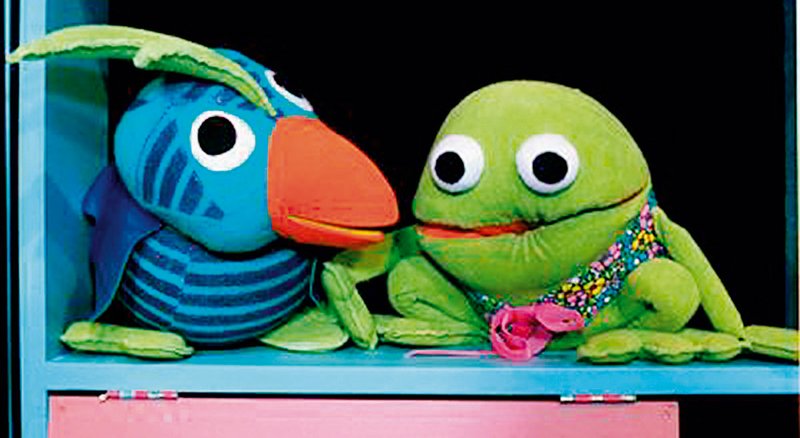
Kaj and Andrea were part of the programme Legestue (Play Room), which was broadcast by the Danish Broadcasting Service (DR) from 1969. It was not only politicians and the culturally conservative and religious right wing who criticised programmes made by DR's Children and Youth Department; the left, including the Danish Union of Early Childhood and Youth Educators (BUPL), also criticised the programmes’ content. Among other things, Legestue was accused of supporting private property rights, and the popular puppets, with their human-like appearance and lack of genitalia, were criticised for encouraging children to engage in escapism. Photo: DR/Ritzau Scanpix
B&U’s desire to represent the many aspects of children’s lives, including the differences of interest between children and adults, is a good example of how the cultural revolution took shape in the 1970s. From the end of the 1960s, schools, museums, after-school clubs and kindergartens introduced children to theatre, literature and film that took its point of departure in children’s reality rather than the adult world to which they would later belong.
In the 1970s, the desire to represent children’s interests through children’s culture saw parallels in workers’ and women’s literature. By portraying living conditions for women, workers and those living in rural areas, the authors of the time wished to illustrate the structural inequality between the sexes, between the classes and between the city and the countryside. These themes could be found in works of fiction such as Vita Andersen’s Tryghedsnarkomaner (Security Junkies, 1977) and Grethe Stenbæk Jensen’s Konen og æggene (The Woman and the Eggs, 1973), but also in the self-help book Kvinde kend din krop (Woman, Know Your Body, 1975), which sold more than 100,000 copies. The aim of the latter was to help women understand their own bodies and to stand up against the male-dominated system of medical treatment.
The dominant cultural trends of the 1980s can be viewed as a counterpoint to those of the 1970s. On television, in films and in literature, the emotions and imagination were prioritised more highly than in the previous decade. On children’s television, programmes such as Bamses Billedbog (Teddy’s Picture Book, 1983–2008) were designed to give children a sense of security and to stimulate their creativity in a time when educational experts feared that more working mothers meant less adult contact for children, and that life in a suburban house and increased urbanisation limited children’s opportunities to play in nature.
Emotions and intimacy were explored in literature, where poetry was given a renewed significance by poets such as Michael Strunge (1958–1986), Pia Tafdrup (born 1952) and Søren Ulrik Thomsen (born 1956). These young poets often found inspiration in rock music. The resulting combination of what was previously viewed as high culture (poetry) and popular culture (rock music) is an excellent example of how popular culture gained an increasingly recognised position throughout the period.
Another cultural phenomenon imported from the English-speaking parts of the world was the ‘yuppie’ (the young urban professional). This phenomenon referred to a small group of capitalist and consumerist yet culturally conservative youth, who – along with their left-wing counterparts, the squatters’ movement (besætbevægelsen) – constituted the leading youth movements of the 1980s. Both these movements can be seen as cultural responses to the same challenge: that the youth did not believe the welfare state was the answer to their problems or aspirations. The yuppies adopted a neoliberal logic in which every individual had to be the architect of their own fortune, since the state, through its re-distributive levelling of inequality, could not meet the individual’s needs. The squatters, named after their focus on squatting empty houses and buildings, also took matters into their own hands, but they opposed capitalism and private property and wanted to get rid of the state, which they saw as suppressing the individual and protecting those in power. Unlike collective movements of the 1970s such as the hippies and the women’s movement, the ideas of the yuppies and the squatters were characterised by the freedom not to pursue a collective goal when opposing existing systems.
Punk music played a central role in the squatters’ movement, but punk bands did not attract the biggest crowds in the 1980s. Rather, it was family rock and roll bands, such as Shu-bi-dua, which appealed to most people. Rock as a genre had become mainstream; with their wide-ranging pop rock, bands and musicians from the city of Aarhus such as TV-2, Gnags and Anne Linnet Band set record sales throughout the 1980s. In collaboration with the film producer Erik Balling, the leader of the 1970s rock band Gasolin’, Kim Larsen, achieved major success with the soundtrack to the film Midt om natten (In the Middle of the Night, 1984). This film, which was seen by over 800,000 people, was critical of both the squatters’ romantic notions of an alternative society and capitalism as the ideal basis for the welfare state.
The question of cultural identity and diversity took a new turn in the 1980s and particularly in the 1990s. Whereas challenges to established culture in the 1960s and 1970s came from lesser-known forms of art and culture such as performance art, pornography and popular culture, and largely concerned struggles between elite and mass culture, challenges in the 1980s shifted to focus on the issue of so-called foreign culture(s) versus what were perceived to be traditional Danish culture values.
Religious, cultural and linguistic minorities were not new in Denmark, but their position in relation to the dominant culture was discussed more consistently and persistently in the 1980s and 1990s than at any other point in the twentieth century. Admittedly, strong democratising trends had already challenged existing notions of a relatively unambiguous Danish cultural tradition, but primarily from a gender and class perspective rather than from a national or religious perspective. For this reason, the preferences of the immigrant groups that came to Denmark from the 1980s posed particular cultural challenges, and there was great disagreement concerning whether new cultural forms and values, especially those with roots in Islam, could be included in Danish society. Subsequent decades thus came to witness increasing vocalisations of concerns and cultural clashes in this arena.
For the right wing, integration was originally viewed as a personal responsibility, whereas the Social Democrats and the Social Liberals issued integration legislation in 1998. In the 2000s, however, right-wing politicians were also keen to legislate to force immigrant groups to assimilate through a detailed regulation of their cultural and religious expressions and practices.
The position of immigrant women became an Achilles’ heel for the women’s movement in the 1990s. Feminists, along with parts of the left, found it difficult to position themselves in the debate about respecting individual women’s religious choices whilst criticising the cultural and religious patterns that could potentially lead to the suppression of women. As such, feminists and the left wing were criticised for failing vulnerable immigrants and refugees in the name of religious freedom.
The women’s movement gradually expanded its focus to the suppressive nature of the patriarchy, regardless of the gender of the victims. In many areas, however, the social and structural challenges remained greater for women than for men. In higher education, for example, the number of female students overtook the number of male students in 1999, but twenty years later, in 2018, nearly 80% of all the positions at professor level were occupied by men – a picture that also pre- vailed in company and director boards. Compared with other Nordic countries, this meant that Denmark was lagging far behind on the issue of equality.
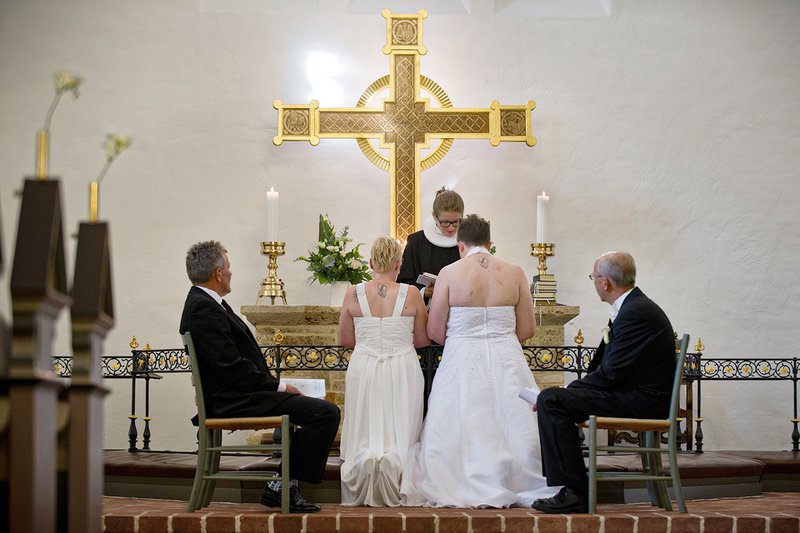
Wedding in Åbyhøj Church, 2012. In 1989, a law on registered partnerships between two people of the same sex was adopted as the first of its kind in the world, though same- sex couples were only legally allowed to marry in church from 2012. In 1996, the Folketing passed a law against discrimination on grounds of sexual orientation, race, religion, political beliefs, age or disability. Gendered and normative notions of family life, however, remained a point of contention in public debate. Among other things, this meant that lesbian and single women only received the right to artificial insemination in 2006. In 2017, Denmark was the first country in the world to remove being transgender from its list of mental illnesses. Photo: Gorm Branderup, Jyllands-Posten/Ritzau Scanpix