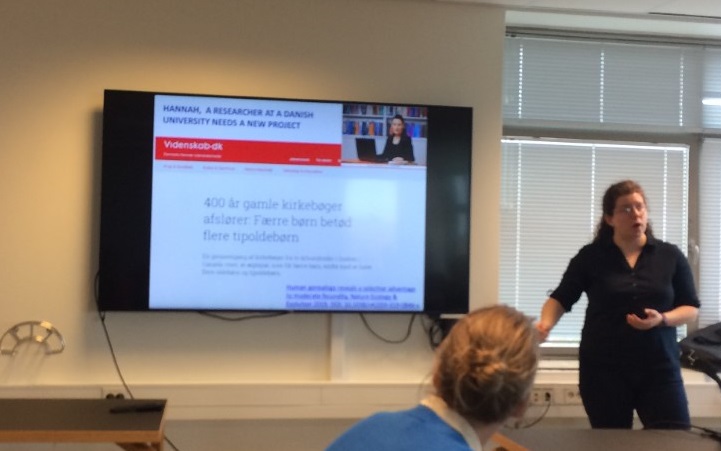
CEDHAR held its first meeting in the semester the 23rd of September.
The meeting was held in connection with a talk by archivist and associate professor at the University of Copenhagen, Bárbara Revuelta-Eugercios. She presented the Link-Lives project and gave the audience an example of the process of how Rigsarkivet (Danish State Archive) has created this unique database where the same individuals can be traced in distinct sources.
Conclusively, it is a great leap forward for the demographically interested (digital) historian and an important contribution to digital scholarship in the humanities.
September has in general been a hectic month for the CEDHAR directors who have been organising and teaching an Archive Week. Adéla and Helle, with the assistance of Aarhus Stadsarkiv (Aarhus City Archive) and Rigsarkivet Viborg, (Danish State Archive, Viborg) have given the new generation of history students the tools to begin working with digital sources, such as the ones the Link-Lives project now has made available.
The next CEDHAR meeting will take place on the 23rd of October and will be connected to the Teaching Digital History Workshop seminar. Remember that deadline for registering is the 8th of October.
Today’s meeting had as key focus the showcases and discussions of Christian Djurslev's and Jakob Ladegaard’s two projects use of digital methods. Afterwards reproducibility in the humanities was discussed on the basis of the Lowndes (and others) text “Our path to better science in less time using open data tools” (2017).
Djurslev was interested to look into the use of digital methods to analize the perception of three famous oriental kings in the Christian Western Europe. To accomplish the task, Djurslev looked into a corpus of Latin texts to determine the connotations the three kings had and to see which texts created literary patterns which were copied in later texts. Djurslev used “R” and “Tracer” as tools to quantify and sort the mentions and which words that are related to these figures and remarked that the process went from the quantitative phase to a manual qualitative phase of close reading to determine actual contextual meaning. It was remarked that the manual phase could have been eased using the function tidytext in R which Odsbjerg showed on our last CEDHAR meeting. It was a furthermore mentioned that the scholarly tradition in classics (as in other fields) holds a limited number of authors to be canon, which is something the digital methods have the capability to change, as it brings scarcely red sources back into the light to provide a more nuanced picture of a given subject.
Ladegaard’s project was on the depiction of inheritance in early modern English plays. He used digital methods to construct social network analysis on plays from a corpus from digitalized collections from British libraries. His project intends to quantify the importance and behaviour of different roles. A conclusion was that the digital methods did not show anything surprising regarding the inheritance question, but it did bring to the researchers’ attention to the role of the minor characters which changed in later plays. There were several issues with the use of digital methods in the project, whereas one was the poor directions and abbreviations of the manuscripts which made it difficult for the computer to understand who is who and who is talking to whom. Additionally, the corpus was discussed regarding the criterion for the selection of plays.
Finally, the reproducibility was discussed in humanities in general. The Lowndes paper emphasises the use of software like Git.Hub and R as excellent and important tools to reproducibility. However, the scripts that can be used for reproduction depend on a certain version of the software while the software world changes. However, the OpenSource environment would always provide a new alternative where fundamental data skills make learning new programming software a lot easier. Everything can however not be digital and there is always a need for analogue alternatives.
The CEDHAR meeting today was centred around the discussion of two showcases and a discussion of a white paper from the Roy Rosenzwig Center for History and New Media on “Digital History and the Argument”.
The first showcase was presented by Lone Kølle Martinsen. Lone has used digital methods in a project about the use of the word “woman” in the authorship of N.F.S. Grundtvig and its relation to the more frequent use of “woman” in the years after 1870. She described her experience with digital methods as “Conceptual History on Speed”, as she was able to analyse a large dataset quickly. Among the problems she encountered, the most fundamental were: the computer not understanding certain words (OCR quality), problems related to the limitation of source material available digitally, as well as understanding the mathematical principles which highlights certain words rather than others (limits to computational literacy). Moreover, the question of where to publish the findings from this (and similar) digital history projects arose during the discussion, as the method section/discussion of methods would look very different from that seen in traditional history journals. Another question was how to give credit to (or co-author with) collaborators.
Jens Bisgaard and Max Odsbjerg Pedersen’s presentation focused on the methods they had used when textmining of the Danish parliamentary records from the 1950’s until 2009 to find the most discussed topics in Danish cultural politics 1961-2009. Jens and Max had used R combined with frequency tools from Tidytextmining.com as Term Frequency and Inverted Document Frequency. See the script in action on data from Aarhus State Archive here. The discussion following this presentation focused on the possible uses of digital methods to challenge established periodization and topics of interests within a certain historiography.
At today’s meeting Kristoffer Nielboe introduced the Center for Humanities Computing (CHC). It is a research-oriented center engineered to aid researchers who are working with big data. It is possible to seek aid to a certain project or a certain task. The CHC is interested to collaborate with CEDHAR as its userbase comes from centers of digital methods, such as CEDHAR.
Planned activites for CEDHAR:
March/April | Workshops: Geospatial Concepts and Data (21-03-2019) Introduction to R (02-04-2019) Intermediate R (03-04-2019) |
May | Workshops: Fundamental Data Skills (21-05-2019-22-05-2019) |
June | Tropy introduction to be scheduled |
July | Adela and Helle teaching “When Archives become Digital” 22-07-2019 – 26-07-2019 |
Furthermore, CEDHAR is interested in showcases concerning Digital Methods.
There were expressed interest to create a Scandinavian Summer School of Digital Humanities in Aarhus. However, it is not possible for CEDHAR at the moment to organize that kind of event. There was a wide-spread recognition of the need of an organizing tool for scheduling, so different Digital Methods centers did not place activities on top of each other. Slack was presented as a solution, and coordinating efforts will be investigated further.
Finally, Niels Brügger introduced Netlab which is part of DIGHUMLAB. Netlab works like CHC to provide assistance regarding the use of digital methods for researchers, however Netlab specialises in archival research. Netlab also offers feasibility-support consisting of attaching an IT-developer to your project to solve a specific problem. There were some discussion concerning a CEDHAR workshop involving Webarchive and the use of code to search, instead of using the search engine of the waybackmachine.
