
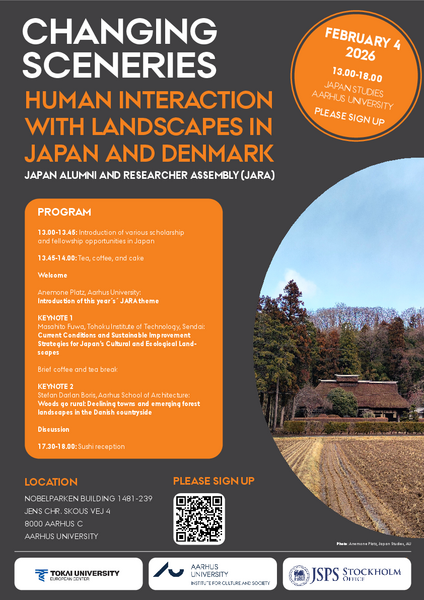
Changing sceneries: Human interaction with landscapes in Japan and Denmark. Please register!
Keynote lectures by Masahito Fuwa, Tohoku Institute of Technology, Sendai and Stefan Darlan Boris, Aarhus School of Architecture. Arranged by Japan Alumni and Researcher Assembly (JARA)
Oplysninger om arrangementet
Tidspunkt
Sted
Nobelparken, building 1481-239, Jens Chr. Skous Vej 4, Aarhus University
Arrangør
PLEASE REGISTER!
https://event.au.dk/events/jara-2026-changing-sceneries
PROGRAM
- 13.00-13.45: Introduction of various scholarship and fellowship opportunities in Japan
- 13.45-14.00: Tea, coffee, and cake
- Welcome
- Anemone Platz, Aarhus University: Introduction of this year´s´ JARA theme
- KEYNOTE 1: "Current Conditions and Sustainable Improvement Strategies for Japan’s Cultural and Ecological Landscapes". By: Masahito Fuwa, Tohoku Institute of Technology, Sendai
- Brief coffee and tea break
- KEYNOTE 2: "Woods go rural. Declining towns and emerging forest landscapes in the Danish countryside". By: Stefan Darlan Boris, Aarhus School of Architecture
- Discussion
- 17.30-18.00: Sushi reception
ABOUT THE KEYNOTE LECTURES
KEYNOTE 1: "Current Conditions and Sustainable Improvement Strategies for Japan’s Cultural and Ecological Landscapes". By: Masahito Fuwa, Tohoku Institute of Technology, Sendai:
Today, a growing number of sustainable products are being promoted, and Denmark has been the European model in this area. However, the use of sustainable materials was not the exception but rather the norm across societies.
A comparable trend can be observed in Japan. Japan is well known for its high production of industrial products, which has contributed to the mass production of plastic. Nevertheless, even here, earlier generations commonly relied on sustainable materials in their everyday lives.
In my presentation, which focuses on the rural landscape of Globally Important Agricul-tural Heritage Systems (GIAHS), I aim to illustrate the transformation of thatched-roof houses and the structural patterns of traditional premises forests in Japan. This analysis will provide a foundation for comparing the rural landscapes of Denmark and Japan and the contemporary challenges their protection and revitalization entails.
KEYNOTE 2: "Woods go rural. Declining towns and emerging forest landscapes in the Danish countryside". By: Stefan Darlan Boris, Aarhus School of Architecture:
In 2024 the Danish government and key stakeholders agreed on the Green Tripartite which aims to secure more nature, cleaner water, and a sustainable transformation of Dan-ish agriculture. It is still unclear how the Green Tripartite will be implemented. One thing seems certain: It will have a massive impact on the Danish countryside, not unlike the land reforms, which in 1750-1814 modernised Danish agriculture.
Despite its potential impact, there is lack of spatial and aesthetic considerations about its implementation. This is important, as it will occur simultaneously with a decreasing num-ber of inhabitants as people move from the countryside to urban growth regions leaving behind abandoned buildings, a declining population and vernacular landscapes emptied of former functions.
This lecture explores a landscape-based approach to the double-directed process of aban-donment and the implementation of the Green Tripartite. It does so by using a station town in the Danish countryside as a 1:1 landscape laboratory. It combines the national agendas of strategic demolition with national ambitions for afforestation and new nature. Through research-by-design and on the ground experimentation with ad hoc and situated interventions the hypothesis is that this approach can play a crucial, yet unrecognized, role in understanding the rural as an emerging common ground.
POSTER
Download below